




多模态提示技术:融合文本图像音频的AI应用
提示工程系列已经聊到了第五篇。前面几篇,我们分别讨论了文本提示技术和多语言提示技术,算是把单模态的玩法摸了个大概。从这一篇开始,视角要彻底打开了——我们要跨出单一模态的边界,正式进入多模态提示技术的地盘。这项技术允许AI系统同时处理并理解文本、图像、音频等多种类型的数据,听起来是不是已经开始有意思了
提示工程系列已经聊到了第五篇。前面几篇,我们分别讨论了文本提示技术和多语言提示技术,算是把单模态的玩法摸了个大概。从这一篇开始,视角要彻底打开了——我们要跨出单一模态的边界,正式进入多模态提示技术的地盘。这项技术允许AI系统同时处理并理解文本、图像、音频等多种类型的数据,听起来是不是已经开始有意思了?现在,我们就来探讨,究竟怎么设计和实现那些能看得懂、听得懂、还能说会道的AI系统。
1. 多模态AI的重要性
进入技术细节之前,可以先聊聊背景:多模态AI为什么这么重要?说到底,有五个核心原因值得关注。
- 更接近人类认知:人类理解世界,靠的从来不是单一感官。看、听、触、读……多模态AI追求的,正是这种自然的认知方式。
- 信息的互补性:不同模态之间的信息,往往互为补充。把多模态数据结合起来,才能得到更全面、更准确的判断。
- 广泛的应用场景:从医疗影像诊断到自动驾驶,多模态AI几乎渗透在每个领域。
- 增强人机交互:能看、能听、能说的界面,才是真正自然的交互界面。
- 处理复杂任务:很多任务本质上就是跨模态的——比如视觉问答、图像描述生成,单打一根本玩不转。
2. 多模态AI的基本原理
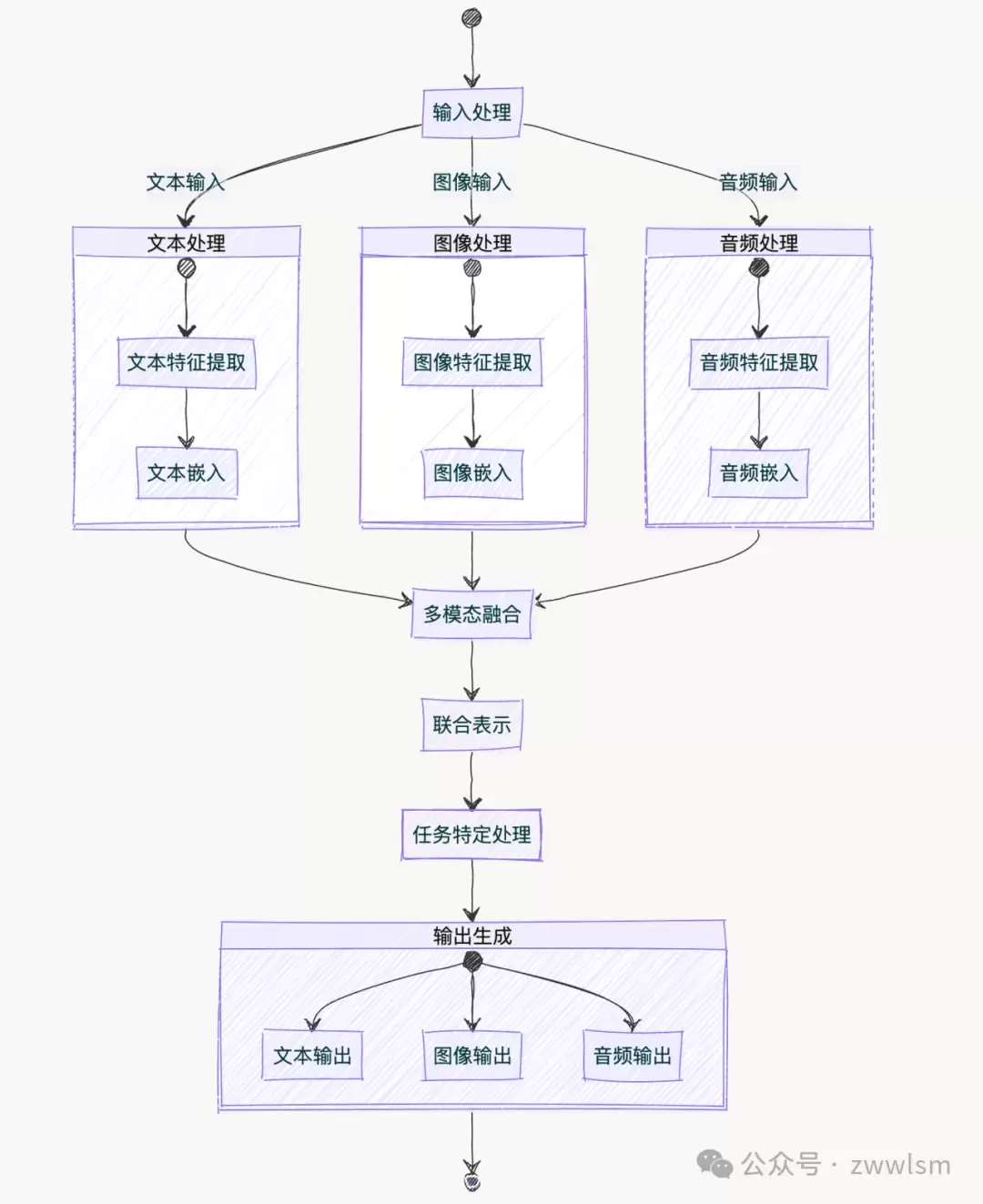
多模态AI的核心,一言蔽之,就是“跨模态信息整合”。它通常走这么几步:
- 特征提取:从各个模态中分别提取有意义的数据特征。
- 特征融合:把不同模态的特征合到一起。
- 联合表示学习:学出一个能统一表示多模态信息的抽象空间。
- 任务特定处理:基于融合后的表示,干具体的活。
3. 多模态提示技术
话不多说,直接进入几种典型的多模态提示技术。
3.1 图文结合提示(Image-Text Prompting)
这大概是目前最常用的多模态提示方式,将图像信息和文字描述结合起来输入给模型。
import openai
import base64

def image_text_prompting(image_path, text_prompt):
    with open(image_path, "rb") as image_file:
        encoded_image = base64.b64encode(image_file.read()).decode('utf-8')

    prompt = f"""
    [IMAGE]{encoded_image}[/IMAGE]

    Based on the image above, {text_prompt}
    """

    response = openai.Completion.create(
        engine="da vinci",
        prompt=prompt,
        max_tokens=150,
        temperature=0.7
    )

    return response.choices[0].text.strip()

# 使用示例
image_path = "path/to/your/image.jpg"
text_prompt = "describe what you see in detail."
result = image_text_prompting(image_path, text_prompt)
print(result)
这段代码示范了如何把图像信息编码进提示词,然后让模型基于图像内容执行任务——本质是让模型“看图说话”。
3.2 音频-文本提示(Audio-Text Prompting)
音频与文本的结合玩法,常用于语音识别、音乐情感分析等场景。
import openai
import librosa

def audio_text_prompting(audio_path, text_prompt):
    y, sr = librosa.load(audio_path)
    mel_spectrogram = librosa.feature.melspectrogram(y=y, sr=sr)
    audio_features = mel_spectrogram.flatten()[:1000].tolist()

    prompt = f"""
    Audio features: {audio_features}

    Based on the audio represented by these features, {text_prompt}
    """

    response = openai.Completion.create(
        engine="da vinci",
        prompt=prompt,
        max_tokens=150,
        temperature=0.7
    )

    return response.choices[0].text.strip()

# 使用示例
audio_path = "path/to/your/audio.wa v"
text_prompt = "describe the main instruments you hear and the overall mood of the music."
result = audio_text_prompting(audio_path, text_prompt)
print(result)
这个例子把音频特征编码到提示词里,让模型基于声音内容做分析或生成。
3.3 视频-文本提示(Video-Text Prompting)
视频更复杂——它既有图像序列又有音频,还多了一个时间维度。
import openai
import cv2
import librosa
import numpy as np

def video_text_prompting(video_path, text_prompt, sample_rate=1):
    cap = cv2.VideoCapture(video_path)
    frames = []
    while cap.isOpened():
        ret, frame = cap.read()
        if not ret:
            break
        if len(frames) % sample_rate == 0:
            frames.append(frame)
    cap.release()

    y, sr = librosa.load(video_path)
    a vg_frame = np.mean(frames, axis=0).flatten()[:1000].tolist()
    mel_spectrogram = librosa.feature.melspectrogram(y=y, sr=sr)
    audio_features = mel_spectrogram.flatten()[:1000].tolist()

    prompt = f"""
    Video features:
    Visual: {a vg_frame}
    Audio: {audio_features}

    Based on the video represented by these features, {text_prompt}
    """

    response = openai.Completion.create(
        engine="da vinci",
        prompt=prompt,
        max_tokens=200,
        temperature=0.7
    )

    return response.choices[0].text.strip()

# 使用示例
video_path = "path/to/your/video.mp4"
text_prompt = "describe the main events happening in the video and the overall atmosphere."
result = video_text_prompting(video_path, text_prompt)
print(result)
这个方案把视频的视觉特征和音频特征一起打包进提示词,让模型基于整个视频内容生成描述。
4. 高级技巧和最佳实践
真刀真枪落地应用时,下面几个技术点可能帮你少走很多弯路。
4.1 模态对齐
不同模态之间的信息必须在语义上对齐——这是模型正确理解多模态输入的前提。
def align_modalities(image_features, text_description):
    prompt = f"""
    Image features: {image_features}
    Text description: {text_description}

    Ensure that the text description accurately reflects the content of the image.
    If there are any discrepancies, provide a corrected description.

    Aligned description:
    """
    # 使用这个提示调用模型来对齐模态
4.2 跨模态注意力
引导模型去关注不同模态中与当前任务最相关的部分。
def cross_modal_attention(image_features, audio_features, text_query):
    prompt = f"""
    Image features: {image_features}
    Audio features: {audio_features}
    Query: {text_query}

    Focus on the aspects of the image and audio that are most relevant to the query.
    Describe what you find:
    """
    # 使用这个提示调用模型来实现跨模态注意力
4.3 多模态链式思考
把思维链(Chain-of-Thought)技术从纯文本场景扩展到多模态领域。
def multimodal_cot(image_features, text_description, question):
    prompt = f"""
    Image features: {image_features}
    Text description: {text_description}
    Question: {question}

    Let's approach this step-by-step:
    1) What are the key elements in the image?
    2) How does the text description relate to these elements?
    3) What information from both sources is relevant to the question?
    4) Based on this analysis, what is the answer to the question?

    Step 1:
    """
    # 使用这个提示调用模型来实现多模态思维链
5. 评估和优化
评估多模态AI比单模态系统复杂得多,建议从以下几个角度入手:
- 模态特定指标:对每个模态使用专门指标,如图像的BLEU分数、音频的WER等。
- 多模态综合指标:开发或使用能整体评估多模态融合效果的指标。
- 人工评估:对于生成类任务,人工判断依然是衡量多模态融合质量的黄金标准。
- 错误分析:仔细分析模型在哪些类型的多模态输入上翻车,往往能发现意外的改进方向。
def multimodal_evaluation(ground_truth, prediction, image_features, audio_features):
    text_score = calculate_bleu(ground_truth, prediction)
    image_relevance = evaluate_image_relevance(image_features, prediction)
    audio_relevance = evaluate_audio_relevance(audio_features, prediction)
    combined_score = (text_score + image_relevance + audio_relevance) / 3
    return combined_score

def evaluate_image_relevance(image_features, text):
    prompt = f"""
    Image features: {image_features}
    Generated text: {text}

    On a scale of 1-10, how relevant is the generated text to the image content?
    Score:
    """
    # 调用模型来评估图像相关性

def evaluate_audio_relevance(audio_features, text):
    prompt = f"""
    Audio features: {audio_features}
    Generated text: {text}

    On a scale of 1-10, how relevant is the generated text to the audio content?
    Score:
    """
    # 调用模型来评估音频相关性
6. 实际应用案例:多模态新闻分析系统
来看一个实战用例——多模态新闻分析系统。这个系统需要同时处理文本、图像和视频组成的新闻内容,最终输出综合分析报告。
import openai
import cv2
import librosa
import numpy as np
from transformers import pipeline

class MultimodalNewsAnalyzer:
    def __init__(self):
        self.text_summarizer = pipeline("summarization")
        self.image_captioner = pipeline("image-to-text")

    def analyze_news(self, text, image_path, video_path):
        text_summary = self.summarize_text(text)
        image_caption = self.caption_image(image_path)
        video_features = self.extract_video_features(video_path)
        analysis = self.generate_analysis(text_summary, image_caption, video_features)
        return analysis

    def summarize_text(self, text):
        return self.text_summarizer(text, max_length=100, min_length=30, do_sample=False)[0]['summary_text']

    def caption_image(self, image_path):
        return self.image_captioner(image_path)[0]['generated_text']

    def extract_video_features(self, video_path):
        cap = cv2.VideoCapture(video_path)
        frames = []
        while cap.isOpened():
            ret, frame = cap.read()
            if not ret:
                break
            frames.append(frame)
        cap.release()
        a vg_frame = np.mean(frames, axis=0).flatten()[:1000].tolist()
        y, sr = librosa.load(video_path)
        mel_spectrogram = librosa.feature.melspectrogram(y=y, sr=sr)
        audio_features = mel_spectrogram.flatten()[:1000].tolist()
        return {"visual": a vg_frame, "audio": audio_features}

    def generate_analysis(self, text_summary, image_caption, video_features):
        prompt = f"""
        Analyze the following news content and generate a comprehensive report:

        Text Summary: {text_summary}
        Image Content: {image_caption}
        Video Features:
        - Visual: {video_features['visual']}
        - Audio: {video_features['audio']}

        Please provide a detailed analysis covering the following aspects:
        1. Main topic and key points
        2. Sentiment and tone
        3. Visual elements and their significance
        4. Audio elements (if any) and their impact
        5. Overall credibility and potential biases
        6. Suggestions for further investigation

        Analysis:
        """

        response = openai.Completion.create(
            engine="da vinci",
            prompt=prompt,
            max_tokens=500,
            temperature=0.7
        )

        return response.choices[0].text.strip()

# 使用示例
analyzer = MultimodalNewsAnalyzer()
text = """
Breaking news: A new renewable energy project has been announced today.
The project aims to provide clean energy to over 1 million homes by 2025.
Environmental groups ha ve praised the initiative, while some local communities
express concerns about the impact on wildlife.
"""
image_path = "path/to/solar_panel_image.jpg"
video_path = "path/to/news_report_video.mp4"

analysis = analyzer.analyze_news(text, image_path, video_path)
print(analysis)
这个实现有几个值得注意的设计思路:
- 模块化设计:不同模态的处理被拆成独立方法,方便维护和扩展。
- 预训练模型调用:直接使用成熟的文本摘要和图像描述模型,效率和质量都有保证。
- 特征提取:视频端同时提取了视觉和音频特征,实际落地时可以考虑更复杂的提取方案。
- 综合分析:最终用一个大模型把所有模态的信息拼成一份完整的分析报告。
- 结构化提示:提示词里包含了明确的分析框架,模型输出才不会跑偏。
7. 多模态提示技术的挑战与解决方案
技术再酷,也不能回避几个核心难题。
7.1 模态融合的复杂性
挑战:不同模态的特征尺度和分布差异很大,直接融合容易导致某些模态的信息被忽略。
解决方案:
- 用注意力机制动态调节各模态的重要性。
- 设计专门的融合层,专门习得模态间的交互模式。
- 在提示词里明确告诉模型该怎么权衡不同模态的信息。
def attention_based_fusion(image_features, text_features, audio_features):
    prompt = f"""
    Given the following features from different modalities:
    Image: {image_features}
    Text: {text_features}
    Audio: {audio_features}

    Please analyze the importance of each modality for the current task,
    assigning attention weights (0-1) to each. Then, provide a fused representation
    that takes these weights into account.

    Attention weights:
    Image weight:
    Text weight:
    Audio weight:

    Fused representation:
    """
    # 基于注意力的模态融合
7.2 跨模态一致性
挑战:不同模态间的信息互相“打架”是常有的事,模型得学会识别并处理这种矛盾。
解决方案:
- 提示词里明确要求模型检查跨模态一致性。
- 设计专门的一致性检验任务,提升模型这方面的能力。
- 训练数据中有意混入不一致样本,提高模型的鲁棒性。
def cross_modal_consistency_check(image_description, text_content, audio_transcript):
    prompt = f"""
    Image description: {image_description}
    Text content: {text_content}
    Audio transcript: {audio_transcript}

    Please analyze the consistency across these modalities:
    1. Are there any contradictions between the image, text, and audio?
    2. If inconsistencies exist, which modality do you think is more reliable and why?
    3. Provide a consistent summary that reconciles any discrepancies.

    Analysis:
    """
    # 跨模态一致性检查
7.3 计算复杂性
挑战:多模态处理意味着数据和模型都更重,推理时间难免拉长。
解决方案:
- 采用模态特定的压缩技术削减数据量。
- 设计高效的多模态架构,比如级联处理或条件计算。
- 提示词里加入对计算效率的考虑。
def efficient_multimodal_processing(image_features, text_content, audio_features):
    prompt = f"""
    Given the following multimodal input:
    Image features (compressed): {image_features}
    Text content: {text_content}
    Audio features (compressed): {audio_features}

    Please perform the analysis in the following order to maximize efficiency:
    1. Quick text analysis
    2. If necessary based on text, analyze image features
    3. Only if critical information is still missing, analyze audio features

    Provide your analysis at each step and explain why you decided to proceed to the next step (if applicable).

    Analysis:
    """
    # 高效多模态处理
8. 未来趋势
多模态AI还在快速发展期,有几个方向值得关注:
- 端到端多模态学习:未来模型可能直接从原始多模态数据学习,不再需要手动提取特征。
- 跨模态生成:基于一种模态生成另一种模态的输出,比如文本 → 图像,或者文本 → 视频。
- 多模态常识推理:模型将更好理解多模态信息中的隐含常识,提高跨模态推理能力。
- 个性化多模态交互:AI根据用户偏好与背景,灵活调整多模态交互方式。
- 多模态隐私保护:在医疗诊断等敏感领域,数据隐私保护会变得愈发重要。
9. 结语
多模态提示技术,正把AI的能力边界从纯文本向外大大拓展。通过本文介绍的技术和最佳实践,相信你已经有了打造多模态AI应用的足够素材。当然,这个领域挑战依然密集,需要持续探索和迭代。随着技术不断演进,多模态AI最终会让我们更自如地理解和处理这个复杂世界。
你是一名 AI 行业编辑,请围绕下面这条热点输出一份资讯解读:
热点:多模态提示技术:融合文本图像音频的AI应用要求:
1. 先用一句话解释这条热点在讲什么
2. 再总结它为什么重要
3. 说明会影响哪些 AI 产品或内容方向
4. 最后给出 3 个适合资讯站使用的标题
游乐网为非赢利性网站,所展示的游戏/软件/文章内容均来自于互联网或第三方用户上传分享,版权归原作者所有,本站不承担相应法律责任。如您发现有涉嫌抄袭侵权的内容,请联系youleyoucom@outlook.com。
 相关热点
相关热点创维汽车正式发布了S710的官图及部分配置信息。新车基于800V高压平台打造,全系采用宁德时代电芯,配备88kWh三元锂电池,CLTC纯电续航里程达710公里。车辆搭载了ADC自适应阻尼减振系统以提升舒适性,并支持100kW直流外放电。内饰设计有所更新,取消了旋钮换挡,增加了50W无线充电等功能。新
上海证券交易所近日向券商下发通知,要求强化交易业务单元管理。通知明确,券商需立即启动全面自查,并对存量不合规配置在3个月内完成整改,核心是确保交易单元分配公平,严禁为个别投资者提供特殊便利,保护中小投资者权益。业内人士指出,此举主要针对量化交易,旨在消除因专属交易通道带来的速度优势,防止普通投资者订
博杰股份拟非公开发行募资不超15 03亿元,用于服务器检测设备及散热模组零部件产能建设、先进研发中心建设并补充流动资金,旨在强化AI服务器产业链布局,把握市场机遇。
国际贵金属市场短线拉升,现货黄金涨1 23%至4488 65美元 盎司,现货白银涨1 66%至73 91美元 盎司。金银价格同步上扬反映短期避险需求,波动受市场情绪、经济数据及地缘因素影响,投资者需审慎决策。
- 日榜
- 周榜
- 月榜
热点快看